




Blade Geometry, Cutting Teeth Styles, Shaft Dimensions, and Connecting Fittings Name Different Product Information
2026-08-19 16:21:28
The four parameter groups are easy to confuse because they all sound like customization options. In practice, they answer different physical questions. A product researcher can use them as a mental map of the blade: what the cutting end looks like, how the edge is formed, how the shaft is proportioned, and how the device connects to the powered system. This does not replace drawings, samples, or technical files, but it gives each discussion a clearer starting point.
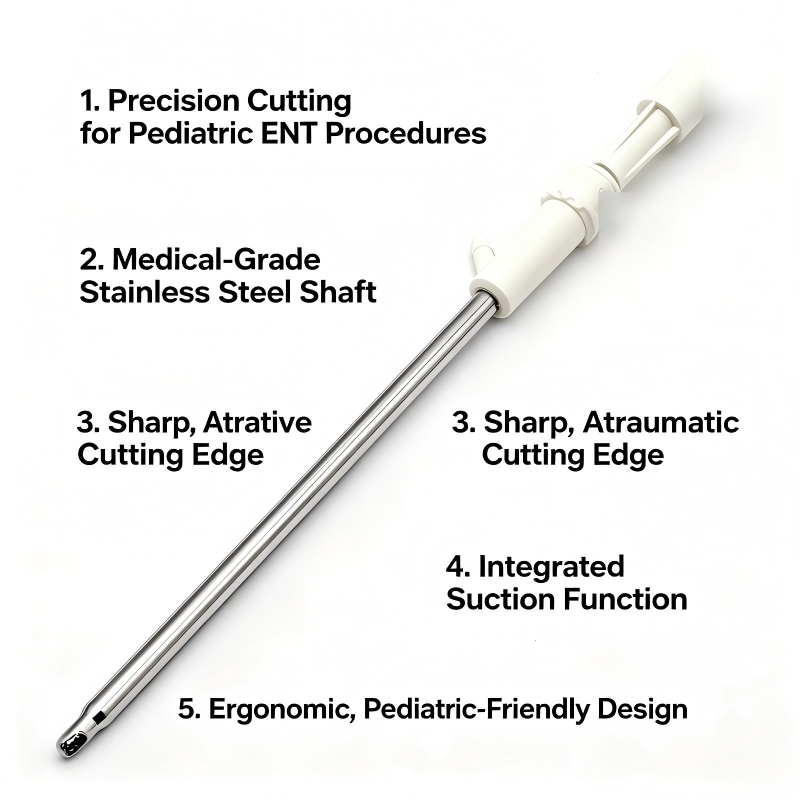
• Blade geometry points to the shape, angle, opening, and working form of the cutting end. In shaver blade geometry customization, the key idea is spatial form: how the blade head is built and how its cutting zone is presented, without assuming a disclosed clinical effect or a standard catalog shape.
• Cutting teeth styles describe the pattern of the cutting edge, not the total size of the instrument. Cutting teeth styles customization may involve how the cutting features are arranged or shaped, but it should not be used to infer steel grade, hardness, coating, motor performance, or tissue outcome unless those details are separately documented.
• Shaft dimensions describe the body of the shaver blade between the cutting end and the connection area. Shaft dimensions customization for shaver blade discussions can involve length, diameter, or fit-related proportions, but public information for a specific product may not provide exact values, measurement tolerances, or application-specific versions.
• Connecting fittings describe the physical interface concept at the end that relates to a shaver handpiece. Connecting fittings customization for shaver blade work is about the connection structure, but the phrase alone does not prove compatibility with every mainstream handpiece, every brand, or every model family.
The value of this separation is that it prevents false equivalence. A change in cutting teeth style is not the same kind of change as a shaft dimension adjustment. A shaft dimension may affect physical reach, passage, or fit-related discussion, while tooth style belongs to edge configuration. A connecting fitting may be relevant to handpiece matching, while blade geometry belongs to the working end. When these terms are kept in their own zones, the reader can understand an OEM/ODM arthroscopic shaver blade as a built object rather than as a bundle of marketing phrases.
Connecting Fittings and Mainstream Shaver Handpieces Need Conservative Reading
Connecting fittings deserve special care because they sit between structure and compatibility. The phrase suggests that the shaver blade has a connection area intended to work with a compatible powered handpiece or system. It is reasonable to understand this as an accessory relationship: the blade is not used alone, and the connection end matters because it must interact with another device. The FDA’s medical device accessory guidance is useful for understanding the general idea that accessories can support or work with parent devices, but that type of source should not be used to classify a specific shaver blade or conclude that a specific fitting is accepted by every handpiece. A conservative reading is especially important when a description mentions mainstream shaver handpieces without publishing a compatibility list. “Mainstream” is a broad product communication phrase, not a technical interface standard by itself. It does not name brands, models, locking structures, drive mechanisms, shaft tolerances, or validation evidence. For a product researcher, the term belongs in the accessory boundary: it tells you that the connecting fitting is part of the matching discussion, but it does not complete the matching conclusion. Compatibility still depends on detailed interface information, handpiece specifications, and evidence that is not created merely by using the word “customization.” This boundary also helps separate the current topic from a full compatibility article. Here, connecting fittings are discussed as one structural parameter among several. The focus is not to build a handpiece compatibility list or judge which shaver systems are covered. Instead, the parameter anatomy shows why fittings are different from blade geometry and shaft dimensions. Geometry shapes the working end; teeth define the cutting edge pattern; shaft dimensions describe the blade body; fittings describe the connection concept. Only the last category directly touches the handpiece relationship, and even that relationship needs careful confirmation before it becomes a compatibility statement. For SINOWARES, the visible customization directions around blade geometry, cutting teeth styles, shaft dimensions, connecting fittings, and specification tweaks can be read as examples of how an OEM/ODM arthroscopic shaver blade may be discussed structurally. That is different from saying every design is possible or every handpiece is covered. The more precise interpretation is that these are the kinds of physical areas where customization language can be organized. Readers who continue to review the related product information should treat the page as a structure-parameter example and keep detailed sizes, interface types, compatibility models, and performance values as separate technical evidence.
Conclusion
Blade geometry, cutting teeth styles, shaft dimensions, and connecting fittings are not interchangeable terms. They divide an OEM/ODM arthroscopic shaver blade into meaningful structural areas: the working-end form, the cutting-edge pattern, the shaft body, and the connection interface. Reading them this way gives product researchers a clearer vocabulary for understanding customization claims without turning them into purchasing steps or compatibility promises. The most useful next step is conceptual rather than transactional: keep each parameter tied to the physical part it describes, and treat missing values, interface details, and handpiece compatibility as separate information. SINOWARES’ disposable arthroscopic shaver blade information can be read as a related example of these visible customization directions, while exact dimensions, fittings, and matching evidence should remain document-based.
FAQ
Q:What does blade geometry mean in an OEM/ODM arthroscopic shaver blade?
A:Blade geometry means the physical form of the cutting end, including the general shape, working opening, angle, or spatial configuration of the blade head. In an OEM/ODM arthroscopic shaver blade discussion, it helps describe how the blade’s working end is conceived, but it should not be stretched into a claim about exact size, clinical effect, or standard model availability unless those details are separately provided.
Q:How are cutting teeth styles different from shaft dimensions in shaver blade design?
A:Cutting teeth styles refer to the edge pattern that participates in cutting or tissue removal, while shaft dimensions refer to the long body of the blade, such as its proportion, length, or diameter-related fit. The first term belongs to the working edge; the second belongs to the structural body that connects the working end with the handpiece area.
Q:Does connecting fittings customization confirm compatibility with every shaver handpiece?
A:No. Connecting fittings customization means the connection area can be part of the structural customization discussion, but it does not confirm compatibility with every shaver handpiece. Specific compatibility depends on interface design, handpiece model information, dimensional details, and supporting documentation, especially when no public compatible-brand or model list is provided.
Sources / References
Arthroscopy - OrthoInfo - AAOS
Medical Device Accessories - Describing Accessories and Classification Pathways
Related Examples
Recommended reading
- 2026-10-15How Cutting Window Configurations Become OEM Blade Specifications
- 2026-10-09Hysteroscopic Shaver Blade Options for Polypectomy and Myomectomy
- 2026-09-14How the SINOWARES Knee, Shoulder, Wrist, and Ankle Wording Sets the Boundary for This Article
- 2026-09-08Knee and shoulder arthroscopy uses for orthopedic shaver blades




 +86 13823386871
 Address