



Hysteroscopic Shaver Blade Options for Polypectomy and Myomectomy
2026-10-09 15:31:56
Introduction: For polypectomy and myomectomy, lesion location and the tissue-removal task should determine the straight-tip, angled-tip, and cutting-window choices in a hysteroscopic shaver blade.
A central-cavity polyp, an anterior-wall lesion, and a fibroid near the cornua or posterior wall each require a different approach. The practical question is which tip geometry and cutting window let the surgeon position the shaft naturally, bring the window into contact with the target, and work with the integrated suction and irrigation path. Start with the procedure scene, then translate it into the blade drawing.
How Lesion Location Shapes Hysteroscopic Shaver Blade Choice
Hysteroscopy covers the diagnosis and treatment of intrauterine pathology. Operative procedures such as polypectomy and myomectomy take place inside a small, fluid-filled cavity, so lesion location changes the angle of approach. A central-cavity polyp can often be reached with the shaft aligned close to the scope’s working axis. An anterior-wall lesion may require the tip to reach forward while the scope remains in a comfortable position.
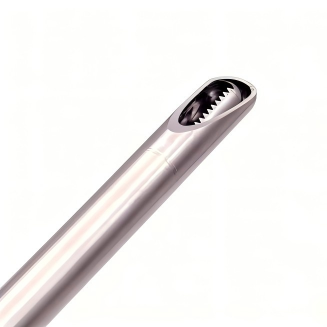
A fibroid near the cornua or posterior wall can sit in a corner where a straight blade forces the shaft into an awkward bend. That is why lesion location should lead the blade configuration brief. Tip geometry, shaft OD, and cutting-window placement all affect reach and control. With OD 2.0–4.0 mm options, the blade can be matched to the cavity and scope path instead of treated as one size. The hollow dual-lumen structure also matters. It supports cutting, suction, and irrigation: the cutting window engages tissue, the suction path removes debris, and the irrigation path supports fluid circulation. The goal is a blade that fits the procedure task, not a catalog item selected by habit.
Matching Straight and Angled Tips to Polypectomy and Myomectomy
Straight and angled tips solve different positioning problems. The right choice depends on where the tissue sits, how much room the scope has to maneuver, and how the surgeon brings the cutting window into contact with the lesion. A blade program can include both forms because one case mix may range from a simple central polyp to a cornual fibroid.
1. Straight Tips Support Central Cavity and Anterior Wall Tissue Removal
A straight tip keeps the cutting axis close to the shaft. For polyps in the central cavity and many anterior-wall lesions, this straight-line approach gives a direct way to advance, engage tissue, and use the suction path to remove debris. The straight form also keeps the tip’s working direction aligned with the shaft, which simplifies planning the approach. In OEM blade design, this usually calls for a direct window position and a shaft that follows the scope without unnecessary lateral offset. Straight tips are often a sensible starting point for polypectomy when the lesion can be reached from a central approach.
2. Angled Tips Reach Cornual and Posterior Lesions Without Excessive Force
An angled tip changes the angle of attack. That matters for polyps near the uterine cornua and myomas along the posterior wall, where the target is not directly in front of the scope. Instead of levering the shaft to reach a corner, the surgeon can use the angled tip to bring the cutting window toward the lesion while the main shaft stays closer to neutral. This supports reach with less forced deflection. In myomectomy, the angled form can help with firm, mobile fibroids that sit off-axis. An angled tip does not replace a straight tip in every case; it is the option to add when the procedure scene includes corners and posterior targets.
Recommended reading
- 2026-10-15How Cutting Window Configurations Become OEM Blade Specifications
- 2026-10-09Hysteroscopic Shaver Blade Options for Polypectomy and Myomectomy
- 2026-09-14How the SINOWARES Knee, Shoulder, Wrist, and Ankle Wording Sets the Boundary for This Article
- 2026-09-08Knee and shoulder arthroscopy uses for orthopedic shaver blades




 +86 13823386871
 Address
